λ = 15.0 μm
1 μm 30 μm

About Me

Sydney Jenkins

Hello! My name is Sydney Jenkins (she/her) and I am a fifth-year graduate student working with Prof. Andrew Vanderburg at the Massachusetts Institute of Technology. I previously earned a BA in physics and BS in computer science at the University of Chicago. My PhD research focuses on the discovery and characterization of planets around white dwarfs.

Outside of science, you can usually find me reading, hiking, or forgetting to water my plants.

Research

In the past few decades, we have discovered thousands of planets orbiting main-sequence stars—stable, long-lived stars like our Sun that are fusing hydrogen in their cores. However, we know relatively little about what happens to these planets once their host stars die. Do planetary systems survive stellar death, and if so, how do they change? My research centers on answering this fundamental question by discovering and characterizing planets around white dwarfs, the Earth-sized remnant left behind when Sun-like stars exhaust their fuel and die. Using JWST and ground-based telescopes, I’m uncovering how planetary systems survive stellar death and evolve over billions of years.

MEOW & PAWS Surveys

Ongoing Observations

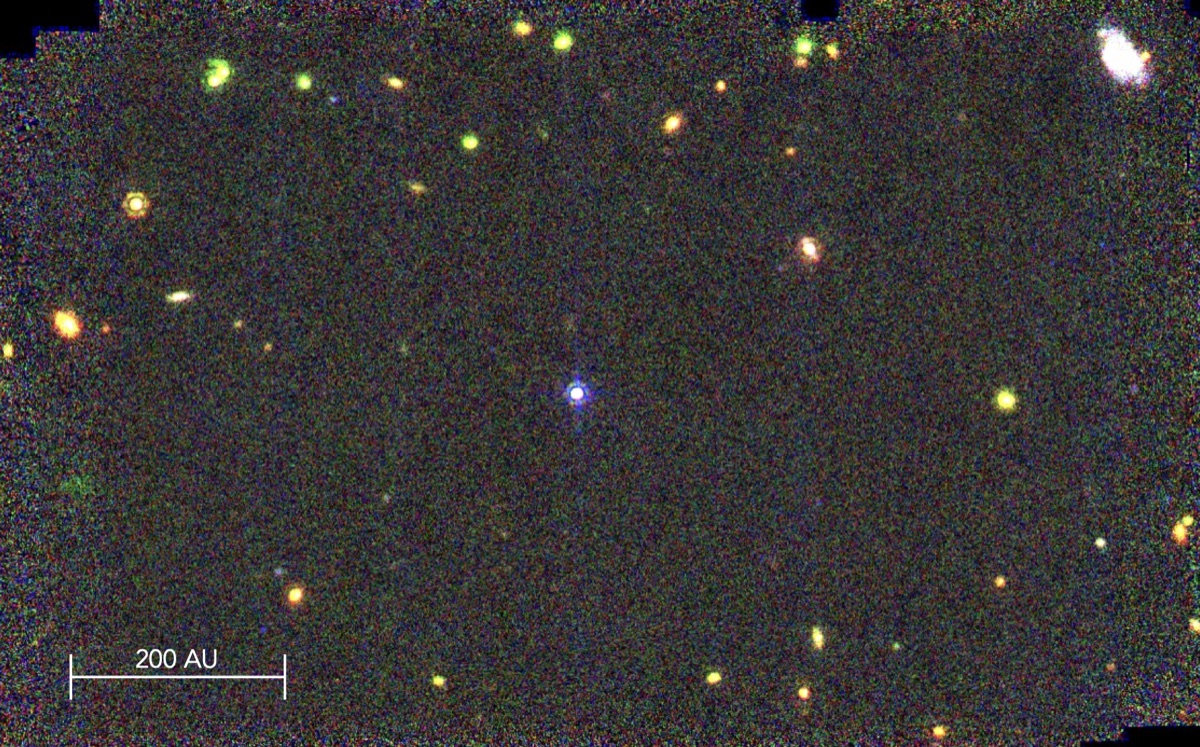
JWST's direct imaging capabilities provide a powerful new tool to probe the demographics of evolved systems by searching for giant planets around white dwarf stars. Two programs leading this effort are the MIRI Exoplanets Orbiting White dwarfs (MEOW) survey and its companion program, the Planet Authentication in White-dwarf Systems (PAWS) survey. MEOW has mapped 16 nearby white dwarf systems with a combination of direct imaging and the thermal excess technique, identifying dozens of planet candidates. Ongoing follow-up observations with PAWS allows us definitively differentiate between true planets and spurious background sources using high-precision proper motion measurements. I am currently using the combined MEOW and PAWS datasets to search for new planets and to place constraints on the demographics of planets around white dwarfs. Our results will have important implications for the post-main-sequence evolution of planetary systems.

False color image of WD 0310-688 taken with JWST/MIRI as part of the MEOW survey

Figure 1: False color image of a white dwarf (WD 0310-688, center) taken with the JWST/MIRI imager as part of the MEOW survey. Image credit: Limbach et al. (including Jenkins) 2024.

Probing the Dynamical History of a White Dwarf Planet

Ongoing Observations

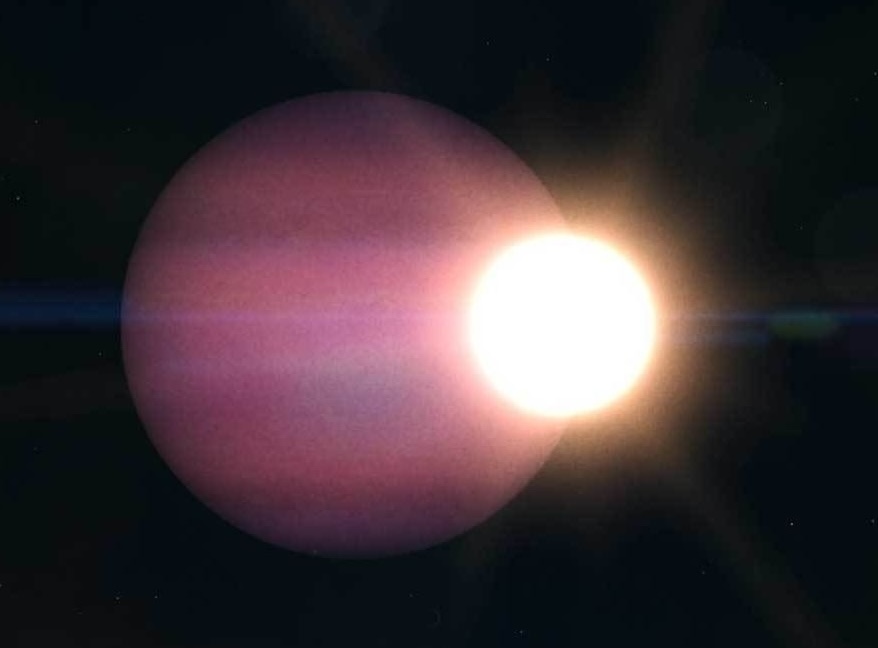
One of the few known white dwarf planets is WD 1856+534 b, which orbits at just 0.02 au from its host star—close enough that it should have been engulfed during the star’s transition off the main sequence. Two main dynamical pathways have been proposed to explain this: high-eccentricity migration and common envelope evolution. I am PI of a JWST program to constrain WD 1856 b’s dynamical history by searching for signatures of common envelope evolution in the planet’s atmosphere. If it did undergo common envelope evolution, it will be the first known planet to have survived engulfment by its star. Regardless of its dynamical history, our program will also probe the atmospheric physics of one of the coldest known planets. These results will provide critical insight into the dynamics of post-main-sequence systems and the atmospheres of cold worlds.

Artist impression of WD 1856+534 b

Figure 2: Artist’s impression of WD 1856+534 and its planet. Image credit: NASA’s Goddard Space Flight Center.

JWST Proper Motion Search for Outer Companions to WD 1856+534 b

In Preparation

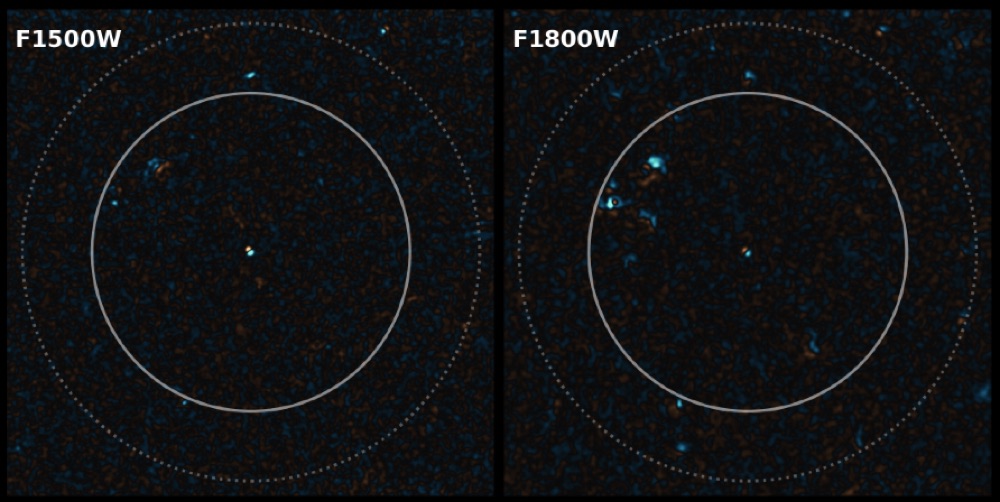
While my JWST observing program is dedicated to searching for signatures of common envelope evolution, we are also performing a complementary search for evidence that WD 1856 b underwent high-eccentricity migration. Using two epochs of JWST MIRI imaging observations, we have measured the proper motions of all nearby sources to identify any potential perturbers. While we do not identify any co-moving planetary companions, we are able to place the first strong constraints on the presence of any distant outer planets. Our combined imaging and TTV constraints rule out planets more massive than WD 1856 b across much of the searched parameter space. If no companion is found within the remaining allowed region, it suggests that either no additional planets are present in the system and WD 1856b migrated via a non-scattering mechanism, or any perturbing planet has a lower mass than WD 1856 b and was likely ejected from the system.

WD 1856+534 proper motion search

Figure 3: Difference images in both the F1500W and F1800W filters. Distant background objects show negligible apparent motion, and therefore have small residuals. In contrast, nearby and fast-moving objects produce prominent positive and negative residuals. The white dwarf, center, exhibits clear motion. No other sources appear to be co-moving with the white dwarf.

Atmospheric Signatures of Common Envelope Evolution

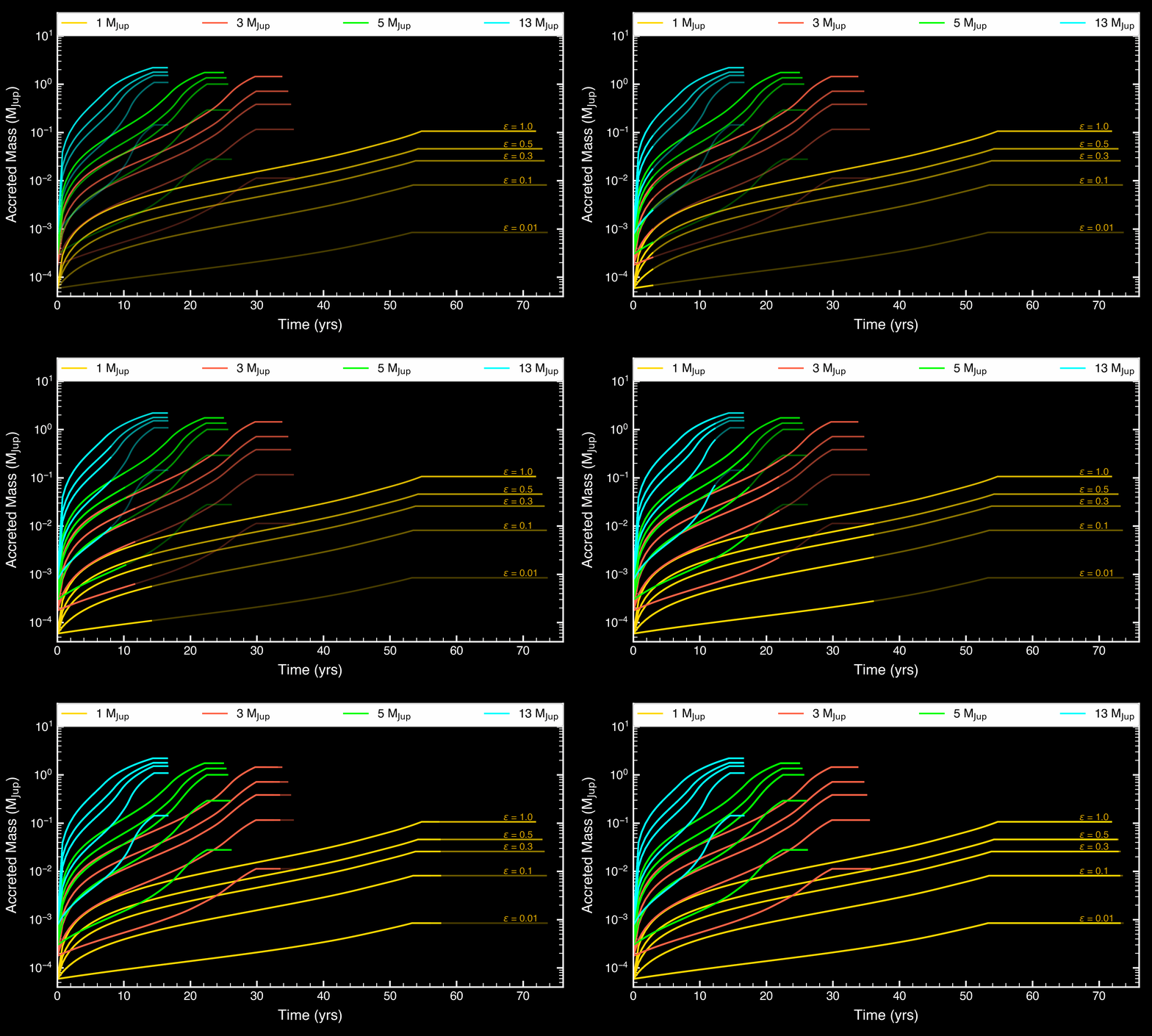
The majority of confirmed exoplanets orbit within 1 AU of a main-sequence star. When their stellar hosts evolve off the MS, many of these planets will be engulfed and destroyed, creating empty “forbidden” zones around the stars as they evolve to their final state as a white dwarf. However, several confirmed and candidate planets have been found within this forbidden zone. Though common envelope evolution is a proposed formation channel for these planets, there are few known signatures to identify a planet that has survived this violent process. We investigate whether the process of engulfment could leave a detectable atmospheric signature by modeling the inspiral and accretion of a planet inspiraling into an AGB star. We then use simulated emission spectra to model the impact of this accretion on the planet’s thermal emission, and find that common envelope evolution can increase thermal emission by up to 9.0% for a cool planet such as WD 1856 b. This signature may be observable in the most favorable cases, providing a potential new probe for investigating the dynamical history of close-in planets around white dwarfs.

WD 1856 b's transmission spectrum

Figure 4: Mass accretion of an engulfed planet over time for a variety of planet masses and accretion efficiencies ε.

Confirmation of TOI-5800 b: An Eccentric Sub-Neptune Moving Into the Evaporation Desert

PublishedRead paper →

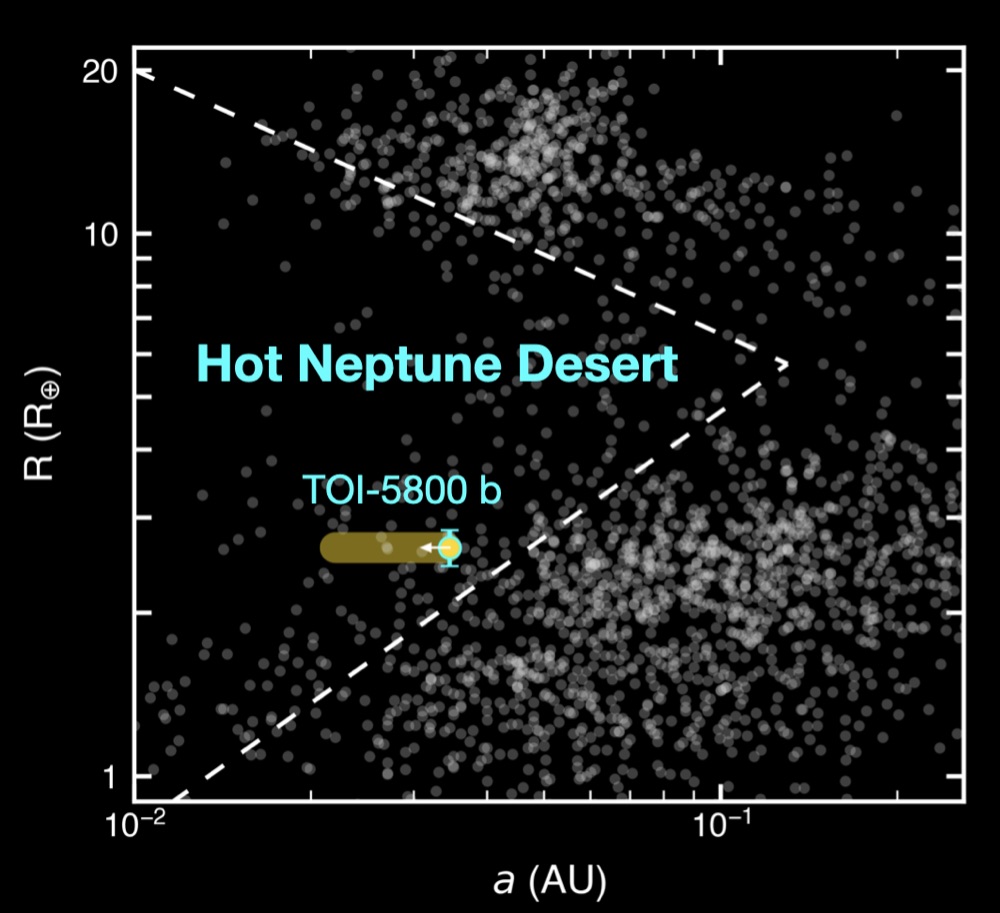
Though missions such as Kepler, K2, and TESS have discovered >2,000 sub-Neptune and Neptunian planets, there is a dearth of such planets at close-in (P≲3 days) orbits. This feature, called the Neptune desert or the evaporation desert, is believed to be primarily shaped by planetary migration and photoevaporation. However, this region is not completely devoid of planets — a small number of very hot Neptunes reside within the desert. These planets provide an opportunity to directly probe the effects of migration and photoevaporation. We present confirmation of TOI-5800 b, an eccentric sub-Neptune on a ≈2.6 day period that is likely actively undergoing tidal migration. We use radial velocity measurements to constrain TOI-5800 b’s eccentricity (0.39±0.07). This eccentricity is unusually high given the planet’s short orbit, suggesting that TOI-5800 is currently experiencing high levels of tidal heating as it moves into the desert. Ranked as a top candidate for transmission and emission spectroscopy within its temperature and radius regime, TOI-5800 b is a prime target for atmospheric characterization with JWST. TOI-5800 b presents a unique opportunity to study the atmosphere of a planet undergoing tidal heating and to probe the composition of sub-Neptune planets.
TOI-5800 b orbital and atmospheric characterization

Figure 5: Radius and semi-major axis of planets listed in the NASA Exoplanet Archive. The Neptune desert is demarked by the white dashed lines. TOI-5800 b is shown in yellow. We expect the planet to circularize to a closer-in orbit within the shaded yellow region.

Absence of a Correlation between White Dwarf Planetary Accretion and Primordial Stellar Metallicity

Published Read paper →

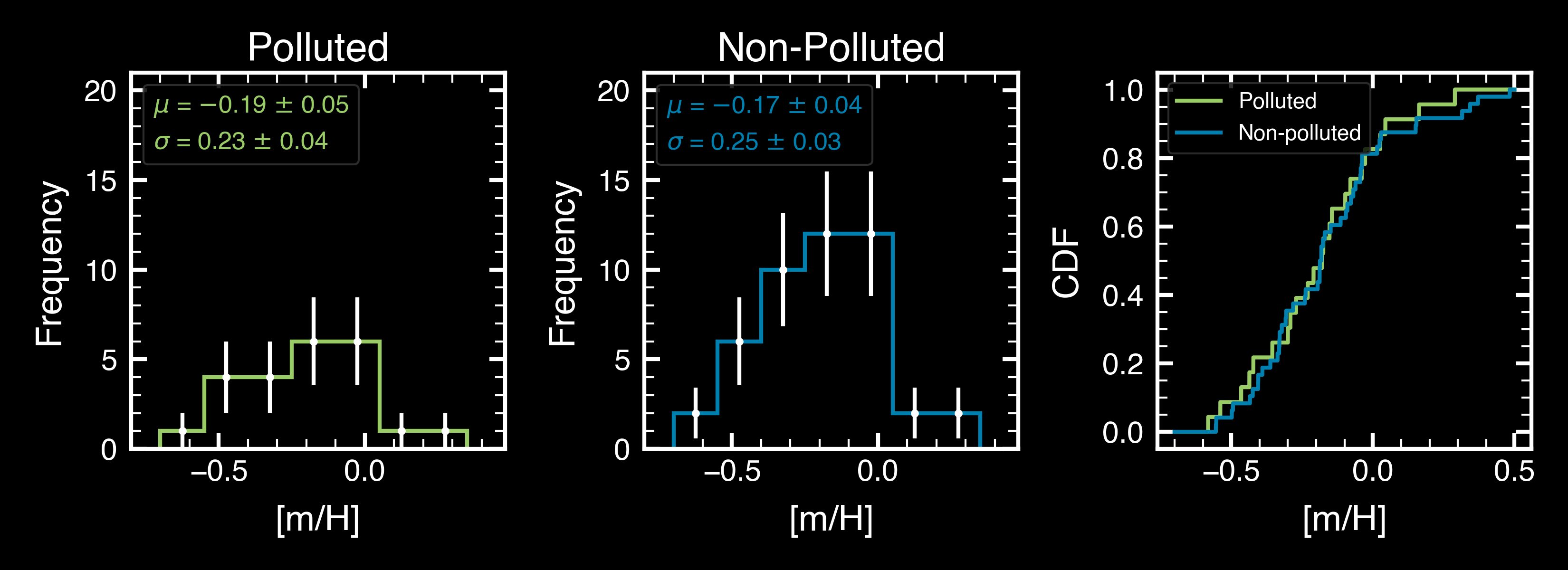
Over a quarter of white dwarfs have photospheric metal pollution, which is evidence for recent accretion of exoplanetary material. While a wide range of mechanisms have been proposed to account for this pollution, there are currently few observational constraints to differentiate between them. To investigate the driving mechanism, we observe a sample of polluted and non-polluted white dwarfs in wide binary systems with main-sequence stars. Because there is a well-known correlation between giant planet occurrence and higher metallicity, we measure each system’s metallicity to probe the role of gas giants in driving white dwarf accretion. We find no significant difference in the metallicity distributions of polluted and non-polluted systems, suggesting that giant planets may not be the dominant cause of white dwarf accretion events in binary systems.

Metallicity distributions of white dwarf systems

Figure 6: Metallicity distributions of white dwarf systems. Left: Metallicity distribution of polluted systems, with error bars shown in white. Middle: Metallicity distribution of non-polluted systems, with error bars shown in white. Right: CDFs of non-polluted and polluted systems, shown in blue and green, respectively.

VLT Spectrsocopy of Ultra-faint Dwarf Galaxies

Published Read paper →

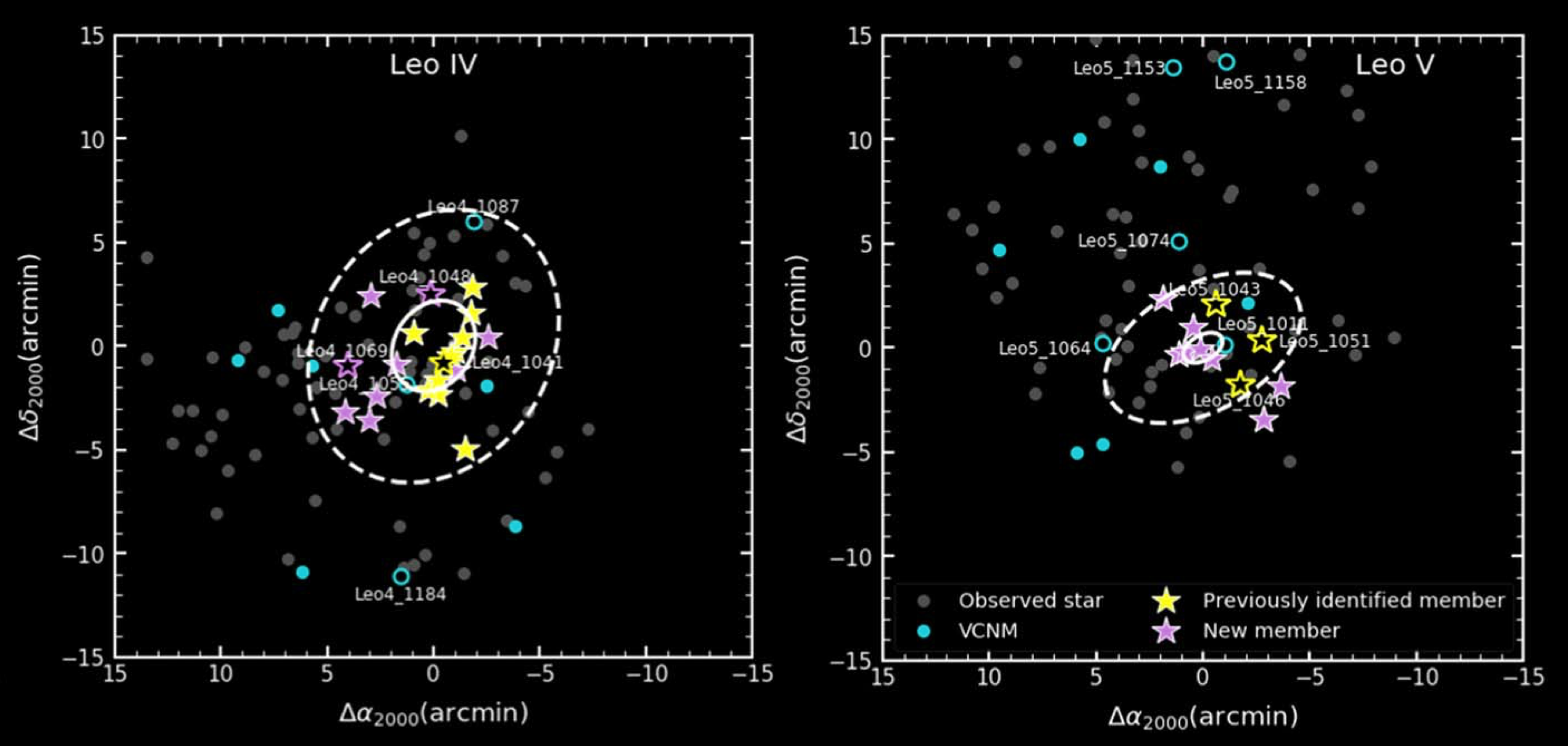
We perform consistent reductions and measurements for three ultra-faint dwarf galaxies: Boötes I, Leo IV and Leo V. Using the public archival data from the GIRAFFE spectrograph on the Very Large Telescope (VLT), we locate new members and provide refined measurements of physical parameters for these dwarf galaxies. We recalculate the velocity dispersions of Boötes I and Leo IV, identify a weak velocity gradient in Leo V, and re-analyze the Boötes I metallicity distribution function. Our analysis of Leo IV, Leo V and other ultra-faint dwarf galaxies will enhance our understanding of these enigmatic stellar populations and contribute to future dark matter studies.

Ultra-faint dwarf galaxy spectroscopy

Figure 7: Positional data for Leo IV and Leo V. Yellow stars represent previously identified members, while pink stars represent new members.

CV

Contact

Email

sydneyaj@mit.edu

Address

Massachusetts Institute of Technology
Deptartment of Physics
77 Massachusetts Avenue, Building 54-1715
Cambridge, MA, 02139-4307, USA

Elements

Text

This is bold and this is strong. This is italic and this is emphasized. This is superscript text and this is subscript text. This is underlined and this is code: for (;;) { ... }. Finally, this is a link.


Heading Level 2

Heading Level 3

Heading Level 4

Heading Level 5
Heading Level 6

Blockquote

Fringilla nisl. Donec accumsan interdum nisi, quis tincidunt felis sagittis eget tempus euismod. Vestibulum ante ipsum primis in faucibus vestibulum. Blandit adipiscing eu felis iaculis volutpat ac adipiscing accumsan faucibus. Vestibulum ante ipsum primis in faucibus lorem ipsum dolor sit amet nullam adipiscing eu felis.

Preformatted

i = 0;

while (!deck.isInOrder()) {
    print 'Iteration ' + i;
    deck.shuffle();
    i++;
}

print 'It took ' + i + ' iterations to sort the deck.';

Lists

Unordered

  • Dolor pulvinar etiam.
  • Sagittis adipiscing.
  • Felis enim feugiat.

Alternate

  • Dolor pulvinar etiam.
  • Sagittis adipiscing.
  • Felis enim feugiat.

Ordered

  1. Dolor pulvinar etiam.
  2. Etiam vel felis viverra.
  3. Felis enim feugiat.
  4. Dolor pulvinar etiam.
  5. Etiam vel felis lorem.
  6. Felis enim et feugiat.

Icons

Actions

Table

Default

Name Description Price
Item One Ante turpis integer aliquet porttitor. 29.99
Item Two Vis ac commodo adipiscing arcu aliquet. 19.99
Item Three Morbi faucibus arcu accumsan lorem. 29.99
Item Four Vitae integer tempus condimentum. 19.99
Item Five Ante turpis integer aliquet porttitor. 29.99
100.00

Alternate

Name Description Price
Item One Ante turpis integer aliquet porttitor. 29.99
Item Two Vis ac commodo adipiscing arcu aliquet. 19.99
Item Three Morbi faucibus arcu accumsan lorem. 29.99
Item Four Vitae integer tempus condimentum. 19.99
Item Five Ante turpis integer aliquet porttitor. 29.99
100.00

Buttons

  • Disabled
  • Disabled

Form